Do psychosocial factors affect the (occupational) well-being of German police officers? A cross-sectional study | BMC Public Health

The study was conducted between July and October 2022.
Subjects
Overall, the total cohort of 253 (209 m/44f) police officers from a single, federal state police force in Germany participated in this study. Three questionnaires were excluded from the analysis due to incomplete responses as the participants did not complete all items up to the final question. The included participants were between 21 and 57 years old (mean age 28.28 ± 6.55 years), had an average height of 179.76 ± 10.65 cm, an average weight of 81.9 ± 12.36 kg and an average BMI of 26.1 ± 2.37 kg/m2. Gender-specific characteristics are shown in Table 1.
Furthermore, Figs. 1 and 2 depict the diverse distribution ranges concerning age and years of service. The biggest age group lay below 24 years (36.2%), followed by the second largest group the 25- to 29-years-olds group (32.9%) (Fig. 1). In addition, 55% of the participants had worked for the police for a maximum of three years (Fig. 2).

Distribution of the participants’ age ranges (in years) and the equivalent percentage of the sample size represented by a pie chart
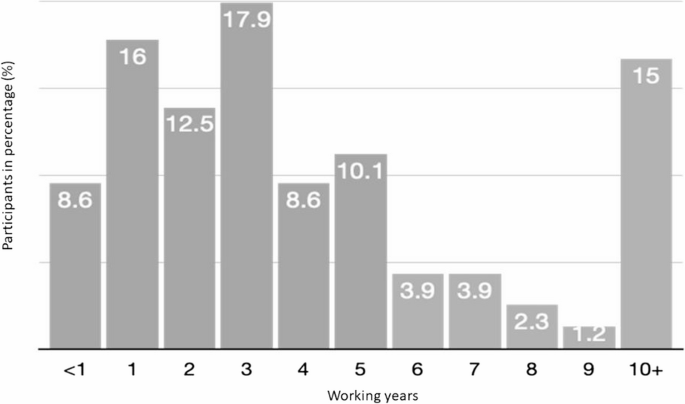
Distribution of the participants’ years of working for the German police with the equivalent share of the sample size in percent %
Inclusion criteria for the subjects were that they should be police officers working for the German police department and be on active duty. Exclusion criteria mainly involved police officers who did not participate in active duties, as well as officers who were working for countries other than Germany. We have submitted a study proposal with an approved ethics application from the Department of Psychology and Sports Science at the Goethe University Frankfurt am Main (No.: 2022-07).
Recruitment
Prior to the survey, informational events were held in which the study and its scientific objectives were presented. All supervisors of the organisational units involved in the survey were present at these briefings. These supervisors subsequently communicated the relevant information to their respective colleagues. Participation in the survey was voluntary. There was a high level of interest among the staff, as they were eager to see the outcomes of a university-led study that directly addressed their specific concerns. Although participation was formally voluntary, the organisational culture within the units strongly encouraged participation, in line with the hierarchical structures typical of public sector authorities. Throughout the entire process, official administrative protocols were strictly followed.
By focussing on general objectives rather than specific outcomes during the pre-survey briefing, suitable conditions were established to minimise potential influences on the participants’ responses, thereby contributing to the robustness of the collected data. Further information can be found in Ohlendorf et al. [24].
Questionnaire survey
Both questionnaires were uploaded to the online platform of the SoSci Survey server where the participants could access them by scanning a QR code. Only fully completed questionnaires were included in the statistical analysis: incomplete ones were excluded. Due to incomplete demographic information, three questionnaires had to be excluded from the analysis. A pretest was conducted with students from the German Police Academy to evaluate the comprehensibility, response consistency and potential biases of the questionnaire prior to its administration to the target group [24]. The selection and exclusion of specific items were systematically assessed to ensure the psychometric validity and reliability of the scales. Due to time constraints and the professional context of the sample group, the COPSOQ was abbreviated. The decision to remove certain items was based on both theoretical and methodological considerations, ensuring that the adapted versions of the COPSOQ and PSQ-Op retained their analytical robustness and relevance. All modifications to the survey instrument were thoroughly reviewed and approved by official representatives from the German Police Department.
Copenhagen psychosocial questionnaire (COPSOQ)
This survey incorporates the German version of the COPSOQ, a self-evaluation tool to assess psychosocial elements in the work environment. The original questionnaire was presented successfully for the first time in 2005 by Kristensen et al. [25] when it was used to assess psychosocial factors at work, stress and the well-being of workers in the public field in Denmark via 141 questions [19]. An international validation study confirmed the validity and reliability of the questionnaire, independent of the language [11]. The COPSOQ is now used worldwide and has been translated into many languages (English, Polish, Spanish, Portuguese, etc.) [25,26,27]. Regarding the present study, a German version was used that had been validated in the study of Nübling et al. [19] in 2006. In this investigation, an occupation-specific modified version was used. A pretest was executed with n = 200 police officer students [24].
In this survey, we covered various aspects including the work demands, influence and growth prospects, work-related factors, social relationships and leadership. From these factors, we were able to assess the possible relationships and impacts on job satisfaction, engagement and overall health.
The answer options for the subjects from the COPSOQ ranged from “to a very high extent” to “to a very low extent”, “always” to “never/almost never”, “very satisfied” to “very dissatisfied” and a timely answer from “never” to “few times a year” to “daily”. Participants of the study could only choose one out of the five possible answers and every single question was evaluated independently. All questions that were relevant for the present study are shown in Figs. 3, 4, 5, 6 and 7.

Graphical representation of the answers for questions on emotions from the COPSOQ. The numbers on the x-axis represent the questions: (1) Does your work entail a significant emotional demand? (2) Does your work require you to hide your own emotions? (3) Does your work demand so much energy that it negatively impacts your personal life? (4) Are you able to apply your skills to your job? The y-axis demonstrates the distribution of the participants (n)

Graphical representation of the answers to the question concerning quitting their occupation taken from the COPSOQ. The x-axis represents the question 1. How often have you considered leaving your occupation in the past 12 months? The y-axis represents the distribution of participants (n)

Graphical representation of the results from the Operational Police Stress Questionnaire. This questionnaire describes the following aspects of police work (x-axis): (1) Shift work; (2) Risk of injuries during work; (3) Paperwork; (4) Having enough time to keep yourself in a good physical condition; (5) Occupational health issues. The colour coding of responses 1–7 on the y-axis describes the intensity of stress levels from dark blue (1: no stress at all) through to orange (4: moderate stress) to medium blue (7: a lot of stress); the higher the number of the colour, the greater the stress level

Graphical representation of the answers for questions concerning the working environment from the COPSOQ. The numbers on the x-axis represent the questions: (1) Do you have to work overtime? (2) Do you have a significant influence on decisions concerning your work? (3) Is the cooperation with colleagues good? (4) How far does the following statement apply: I am full of energy at work? The y-axis demonstrates the distribution of participants (n)

Graphical representation of the answers to questions concerning the physical state from the COPSOQ. The numbers on the x-axis represent the questions: (1) Are you physically exhausted? (2) Are you emotionally exhausted? (3) Are you feeling drained? (4) Do you come to work even when you are feeling sick/unwell? The y-axis demonstrates the distribution of participants (n)
Operational police stress questionnaire (PSQ-Op)
The PSQ-Op was devised in 2006 by McCreary and Thompson [11] and has been used as a valid and reliable assessment [18, 19] since 2013. This questionnaire aimed to investigate the possible relationships between physical health, stress and psychological well-being that are specific to police officers [28, 29]. The German version offered, as answer possibilities, a numerical rating scale ranging from 1, which was defined as moderate low stress, up to 7, which identified a high level of stress (0–3 means no/low stress, 4–5 a moderate level of stress and 6–7 high levels of stress). Each question was individually evaluated.
Participants were instructed to select only one response out of seven answer options per question. In the present study, the original 20-item questionnaire was condensed to five occupation-specific questions (Fig. 8) in order to align more strongly with the unique demands and context of police work.

Graphical representation of the answers to questions concerning the departmental environment from the COPSOQ. The x-axis is represented by the questions on satisfaction:1…with people you work with?2…with how the department is managed/organised? 3…with the wage/salary 4…with the physical conditions 5…with the occupational opportunities. The y-axis represents the distribution of participants (n)
Demographic data, including age, body weight, height and body mass index (BMI), were collected at the beginning of the questionnaire and completed by all study participants. Participants were instructed to provide responses to the best of their knowledge and ability to ensure the accuracy and reliability of the data.
Statistical evaluation
Data collection and descriptive evaluation of the data, including the generation of graphs and the calculation of absolute and relative frequencies, were performed in Excel. Rasch scores based on the polytomous Rasch model by Nübling et al. and Tennant and Conaghan [19, 30] were computed for the set of selected items from the COPSOQ questionnaire, and separately for the set of selected items from the PSQ-Op questionnaire, in R (version 4.3.3) with the “TAM” package. Further analyses were performed with the programme SPSS Statistics 26 (IBM Deutschland GMbH, Ehningen, Germany).
Since no validated scores exist for the sets of selected items and the study population, overall scores provided by the polytomous Rasch model were used to determine a relative assessment of work-related well-being (based on COPSOQ) and work-related stress (PSQ-Op) for each participant. The focus of the Rasch analyses was not on evaluating the performance of individual items but rather on deriving a score for each subset of questions. For both derived scores, higher values indicated a more negative outcome, i.e. higher scores for work-related well-being reflected a lower well-being, and higher scores for work-related stress corresponded to greater stress.
The Wilcoxon-Mann–Whitney U test was conducted to assess differences in anthropometric parameters between male and female police officers. For testing correlations between the participant’s characteristics (such as age, body weight, body height, body mass index, working years, working hours) and work-related well-being and stress, respectively, the Spearman’s rank correlation coefficient was calculated as the Rasch scores were not normally distributed. Normal distribution of the Rasch scores was tested using the Kolmogorov-Smirnov-Lilliefors test. For the interpretation of the magnitude of absolute correlations, the interpretation according to Evans [31] was applied and showed that values of < 0.2 were considered poor, 0.2–0.4 weak, 0.4–0.6 moderate, 0.6–0.8 strong and > 0.8 optimal. The significance level was set at 5%.
link