Latent class patterns of work-life balance changes among Korean SME workers during COVID-19 based on organizational support and psychosocial health
Research design
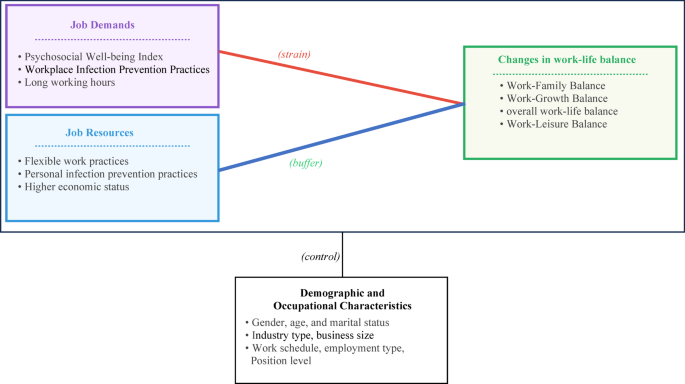
This study employed a descriptive, cross-sectional survey design to examine changes in WLB among Korean workers during the COVID-19 pandemic. The analysis was guided by the JD-R model, which conceptualizes changes in WLB as outcomes influenced by the interaction of job demands and job resources (Fig. 1).

Conceptual framework based on the JD-R model.
Participants and data collection
This study was conducted between July and September 2020 among employees at small and SMEs located in Gyeonggi Province, South Korea. For this study, SMEs were defined as workplaces with fewer than 400 employees, including small enterprises (≤ 50 employees) and medium-sized enterprises (51–400 employees), in accordance with the operational categorization used in Korean occupational health research. The sample included workers from three industry sectors: manufacturing (33.8%), services (45.9%), and construction (20.3%). Due to COVID-19 pandemic restrictions that limited direct access to workplaces, convenience sampling was employed as the most feasible recruitment strategy. The study’s purpose and objectives were communicated to the managers, who provided their consent. Additionally, workers from smaller-scale operations were recruited with the assistance of the Federation of Korean Trade Unions and the Small Workplace Healthcare Association within their operational areas in Gyeonggi Province. Data were collected using self-administered paper questionnaires distributed to participants at their workplaces. The survey was not nationally representative, reflecting the geographic and organizational limitations imposed by pandemic-related restrictions.
Using the G*Power program, we determined that an effect size of 0.15, a significance level of 0.05, a power of 0.95, and 10 predictors would require a sample size of 147. However, latent class analysis typically requires larger sample sizes, with a minimum of 300 participants recommended for stable class estimation25. Therefore, considering a potential 20% dropout rate, we initially surveyed 508 individuals. After excluding six respondents due to incomplete data, we analysed the data from 503 participants.
Ethical considerations
This study was approved by the Institutional Review Board of Eulji University (EU20-034). Written informed consent was obtained from all participants. The objectives of the study were clearly communicated to the participants, who were assured of their anonymity. A consent form was provided, which outlined their right to withdraw from the study at any point without consequence. To safeguard the participants’ privacy, a return envelope was included with the questionnaire, allowing them to seal their responses immediately upon completion. The researcher personally collected the completed questionnaires and provided a box of face masks to participants as a token of appreciation for their participation, which was considered particularly valuable during the COVID-19 pandemic when such protective equipment was essential. All methods were performed in accordance with the relevant guidelines and regulations.
Instruments
The measurement instruments in this study were organized according to the Job Demands–Resources (JD–R) model framework. Job demands refer to physical, psychological, or organizational aspects of work that require sustained effort, while job resources are aspects that help achieve work goals, reduce demands, or facilitate personal growth21.
Changes in WLB due to COVID-19
WLB was measured using an instrument developed by Kim and Park1. This tool comprises 9 questions addressing work-growth balance, 8 questions focused on work-leisure balance, 4 questions pertaining to overall WLB, and 8 questions related to work-family balance, culminating in a total of 29 questions. In this study, participants were asked to evaluate how their WLB had changed due to COVID-19 using a 7-point scale. The scale ranged from 1, indicating a “worse” change, to 7, signifying a “better” change, with higher scores denoting more favourable changes in WLB as a result of COVID-19. For the latent class analysis, we used the four subscale scores (work-growth balance, work-leisure balance, WLB in general, and work-family balance) as indicator variables rather than individual items. Each subscale score was calculated as the means of its constituent items.
Job demands
In this study, psychosocial well-being was conceptualized as an indicator reflecting the cumulative burden of job demands rather than as a demand itself. Poor psychosocial health signals insufficient personal resources to cope with existing demands, making it a relevant outcome measure within the JD–R framework. Workplace infection-prevention practices were regarded as organizational-level demands because they represent the extent to which workers must respond to and manage COVID-19-related risks in their work environments, adding to their cognitive and emotional load. Working hours were treated as traditional time-based demands that limit workers’ opportunities to recover and engage in personal or family activities.
Psychosocial well-being index (PWI)
Social-psychological well-being was assessed using the 18-item shortened version of the Psychosocial Well-being Index (PWI-SF), which was developed by Chang26 and has been validated for both validity and reliability. This instrument includes subscales that measure general health and vitality, social role performance and self-confidence, sleep disorders and depression, as well as depression and anxiety. It employs a 4-point Likert scale ranging from 0 (not at all true) to 3 (always true), where lower scores indicate better social and psychological health. The aggregate score of the 18 items was calculated and categorized into three groups: a healthy group (0 to 8 points), a potentially stressed group (9 to 26 points), and a high-risk group (27 points or more).
Workplace infection prevention practices for COVID-19
Workplace-level COVID-19 infection prevention practices were assessed using a 10-item instrument developed and validated by Jung and Choi27, which was originally designed for small-sized enterprises during the early COVID-19 pandemic and based on the Ministry of Employment and Labor’s workplace response guidelines. The items reflect preventive actions implemented in workplaces during the pandemic, including temperature monitoring at entry points, installation of protective barriers, maintaining physical distance among workers, provision of hand sanitizer, mandatory mask wearing, routine disinfection, restrictions on shared spaces, staggered lunch breaks, and discouragement of indoor smoking. Responses were rated on a 4-point Likert scale ranging from 1 (“rarely implemented”) to 4 (“fully implemented”), with higher scores indicating a greater level of workplace adherence to COVID-19 prevention practices.
Working hours
Working hours were categorized into three ranges: 40 h or less, 40 to 51 h, and 52 h or more per week. These categories were based on the legal standard working hours in South Korea (40 h per week), with 52 h representing the upper legal limit including overtime.
Job resources
Personal infection-prevention behaviors were classified as personal resources because they reflect proactive coping strategies that individuals employ to regain a sense of control and reduce pandemic-related stress. Flexible work arrangements were conceptualized as organizational resources, as they enhance autonomy and adaptability, allowing workers to manage competing work and personal responsibilities more effectively. Subjective economic status was included as a personal resource, representing a psychological and material buffer that mitigates the impact of economic insecurity during crisis periods.
Factors related to a flexible work system
Flexible working was assessed using an instrument developed by Kim28, which was based on prior research. This study categorized sub-factors for facilitating a flexible work system into four groups: institutional factors (such as diversity of types and maintenance of regulations and procedures), organizational environment factors (including manager’s willingness and colleagues’ perceptions), work content factors (appropriate work and workload), and human resource management factors (non-monetary benefits and personnel disadvantages). Participants responded to a total of eight questions on a 5-point scale, where 1 indicated “not at all,” 2 “not,” 3 “moderate,” 4 “yes,” and 5 “very much so.” Two negatively worded items were reverse-scored to calculate the overall mean, with higher scores indicating a more effective flexible working system. Cronbach’s α in this study was 0.716.
Personal infection prevention behaviors for COVID-19
Individual-level infection prevention behaviors related to COVID-19 were assessed using a 10-item scale developed based on the Ministry of Employment and Labor’s guidelines, with input from three occupational health nurses. The items included behaviors such as canceling or postponing social gatherings, reducing use of public transportation and visits to shopping centers, avoiding enclosed public spaces such as karaoke rooms and cinemas, minimizing visits to crowded places, taking extra care with cleanliness and hygiene, washing hands frequently, refraining from physical contact such as handshakes, and maintaining social distancing during meals. Each item was rated on a 4-point Likert scale ranging from 1 (“rarely practiced”) to 4 (“practiced very well”), with higher scores indicating a higher level of personal adherence to infection prevention behaviors.
Subjective economic status
Subjective economic status was assessed using a 5-point Likert scale, where participants rated their perceived household economic condition from 1 (“very low”) to 5 (“very high”). For analysis, responses were recoded into two groups: “low” (scores 1 to 2) and “above average” (scores 3 to 5), as relatively few participants rated their status as “high” (scores 4 or 5). This recording allowed for meaningful group comparison while maintaining sufficient sample size in each category.
Control variables
Demographic and occupational characteristics
Control variables included participants’ gender, age, and marital status. Occupational characteristics included industry type (manufacturing, services, and construction), business size (small: ≤50 employees; medium: 51–400 employees), work schedule (daytime vs. shift work), employment type (regular vs. non-regular employment), and position level (staff vs. supervisor or above).
Statistical analysis
All data were analyzed using Mplus 8.5 and SPSS 26.0 in accordance with the study objectives. First, descriptive statistics (frequency, percentage, mean, and standard deviation) were calculated to summarize the sociodemographic, occupational, and psychological characteristics of the participants.
Second, latent class analysis (LCA) was conducted to classify patterns of changes in WLB due to COVID-19. Model selection was based on a combination of fit indices including the Akaike Information Criterion (AIC), Bayesian Information Criterion (BIC), sample size-adjusted BIC (saBIC), entropy, the Lo-Mendell-Rubin likelihood ratio test (LMR), and the bootstrap likelihood ratio test (BLRT). Lower AIC and BIC values suggest better model fit, while higher entropy values (closer to 1) indicate clearer classification quality. Significant p-values from LMR and BLRT confirm whether a model with k latent classes significantly improves upon a model with k-1 classes29,30. Third, chi-square tests and one-way ANOVA were used to examine differences in participants’ characteristics across the identified latent classes. For ANOVA analyzes that showed significant differences, Scheffé’s post-hoc test was conducted to identify which specific latent classes differed from each other. The Scheffé method was selected because it is conservative and appropriate when comparing groups of unequal sample sizes, as was the case with our three latent classes. Finally, multinomial logistic regression was performed to identify factors associated with each latent class. Only variables that showed statistically significant differences in the prior analysis were included in the final regression model.
link