Legislation looks to continue syringe exchange programs to combat blood-borne disease | Health
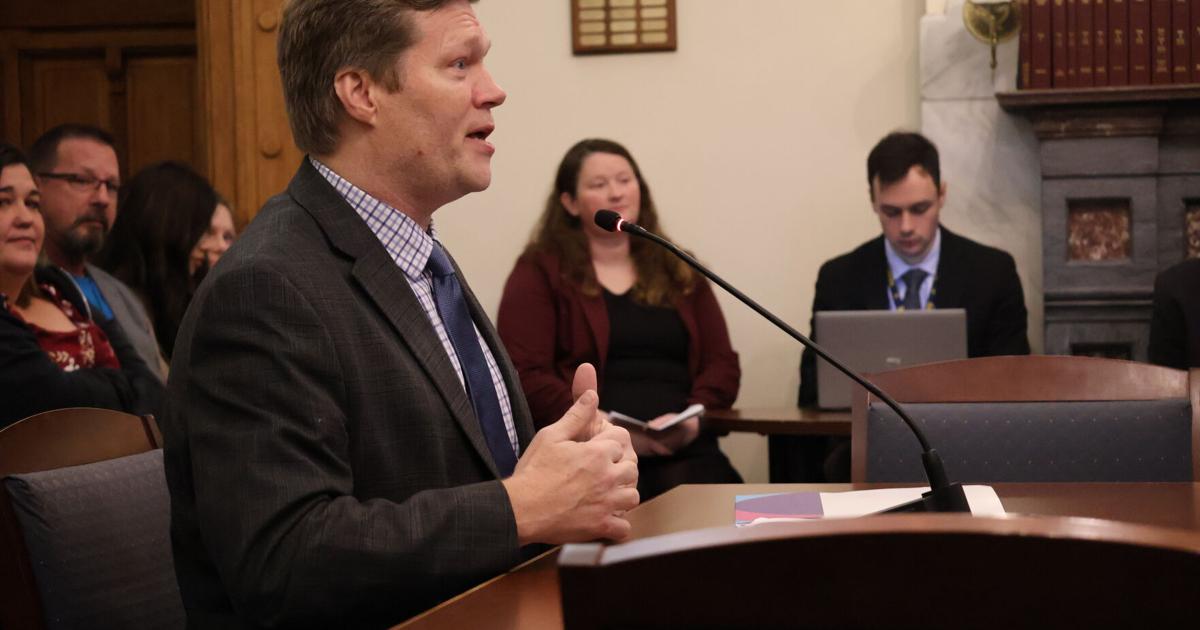


Alan Witchey, president and chief executive officer of Damien Center speaks in support of Senate Bill 91 on Wednesday. “This legislation keeps local control. Every single county in Indiana gets to choose whether they opt in to do it or not do it, and they choose whether or not they want to continue it or discontinue it,” he said. “It is a critical, critical tool for us to stop disease, keep law enforcement safe, to reduce public health causes, to save lives and to get people into recovery.”
A little over 10 years ago, Scott County experienced the largest outbreak of HIV in rural America. Out of the almost 200 cases in 2015, many of them were caused by sharing needles from drug use.
As a response to the outbreak, syringe exchange programs (SEP) were legalized.
SEPs are an initiative that creates a place to allow people that inject substances to receive sterile syringes and other supplies, as well somewhere to properly dispose of used syringes.

Alan Witchey, president and chief executive officer of Damien Center, said speaks in support of Senate Bill 91 on Wednesday.
The program aims to reduce HIV and other illnesses by minimizing user contact with other people’s blood by eliminating syringe sharing. In Scott County, the program reported decreasing syringe sharing from 18% to 2%.
The original law to legalize syringe exchange programs, passed in 2015, had a 10-year time limit, which Senate Bill 91 aims to extend. The bill passed 10-2 in the Senate Health and Provider Services Committee Wednesday and will continue on to a second reading in the Senate chamber, where amendments can be made.
William Cooke spoke in support of the bill as a doctor from the town of Austin, one of the most affected areas in Scott County, who helped lead the response to the HIV outbreak.
“When people understood the stakes and were given safe legal options, they didn’t just protect their own health. They took responsibility for the health and safety of their entire community by almost universally disposing of syringes safely and legally,” Cooke said.

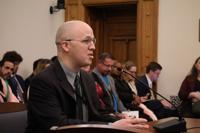
Christopher Daniels, representing the Indiana Prosecuting Attorney’s Council, speaks in opposition to Senate Bill 91 on Wednesday.
Because of a ban in state law, the programs rely solely on outside funding, meaning they take no taxpayer dollars.
The passing of SB 91 does not mean a statewide mandate on needle exchange programs; if passed, each county may decide for itself whether it needs a needle exchange center or not.
Current legislation has several requirements for a syringe exchange program to start, including the declaration of a public health emergency and county approval.
Those in opposition cited concerns about increased needle presence in communities and increased drug usage. One of those people was Christopher Daniels, representing the Indiana Prosecuting Attorney’s Council.
“Our concern is the unintended consequences that when trying to fix one problem in one space, we create another problem in another,” Daniels said.

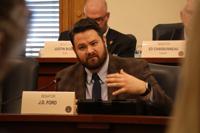
Sen. J.D. Ford, D-Indianapolis, speaks with Christopher Daniels, who represented the Indiana Prosecuting Attorney’s Council, about Daniels’ opposition of Senate Bill 91 on Wednesday.
Daniels cited concerns that by allowing drug users access to needles, there could potentially be more discarded syringes in communities because of the take and return rate of supplies.
“One of our major concerns being the lack of one-to-one exchange in a lot of these needle programs, which results in a proliferation of needles in communities,” Daniels said.
According to ProtectSEP.org, SEPs lead to eight times fewer discarded needles in public places and reduce the chance of an accidental needle stick to law enforcement officers by 66%.
For Morgan Bryant, a recovering former drug user, an SEP changed her life.
“The syringe exchange program provided life-saving tools like Narcan education and access to care that kept people safer and healthier, even when we were still in active addiction,” Bryant said. “Because when we’re out there chasing that next high, running from yourself, you don’t always know who you are anymore.”
Morgan first came to an SEP looking for nothing more than supplies, but through members of the program, she was connected to recovery resources that led her to sobriety almost two years ago.
“I started this journey not knowing that there was even a way out of the epidemic. Today I stand here, looking back, because someone reached out with grace, not judgment,” Morgan said.
link