Neuroimaging insights into the psychosocial impact of the COVID-19 pandemic: a systematic review
Lee K, Jeong GC, Yim J. Consideration of the psychological and mental health of the elderly during COVID-19: a theoretical review. Int J Environ Res Public Health. 2020;17:8098.
Google Scholar
Zhang JJ, Dong X, Liu GH, Gao YD. Risk and protective factors for COVID-19 morbidity, severity, and mortality. Clin Rev Allergy Immunol. 2023;64:90–107.
Google Scholar
Hossain MM, Tasnim S, Sultana A, Faizah F, Mazumder H, Zou L, et al. Epidemiology of mental health problems in COVID-19: a review. F1000Res. 2020;9:636.
Google Scholar
Zaami S, Sirignano A, García-Algar Ó, Marinelli E. COVID-19 pandemic, substance use disorders and body image issues, a worrisome correlation. Eur Rev Med Pharmacol Sci. 2022;26:291–7.
Google Scholar
Chen PJ, Pusica Y, Sohaei D, Prassas I, Diamandis EP. An overview of mental health during the COVID-19 pandemic. Diagnosis (Berl). 2021;8:403–12.
Google Scholar
Vindegaard N, Benros ME. COVID-19 pandemic and mental health consequences: Systematic review of the current evidence. Brain Behav Immun. 2020;89:531–42.
Google Scholar
Brooks SK, Webster RK, Smith LE, Woodland L, Wessely S, Greenberg N, et al. The psychological impact of quarantine and how to reduce it: rapid review of the evidence. Lancet. 2020;395:912–20.
Google Scholar
Raza SH, Haq W, Sajjad M. COVID-19: A Psychosocial Perspective. Front Psychol. 2020;11:554624.
Google Scholar
Zhang J, Lu H, Zeng H, Zhang S, Du Q, Jiang T, et al. The differential psychological distress of populations affected by the COVID-19 pandemic. Brain Behav Immun. 2020;87:49–50.
Google Scholar
Chen Z, Feng P, Becker B, Xu T, Nassar MR, Sirois F, et al. Neural connectome prospectively encodes the risk of post-traumatic stress disorder (PTSD) symptom during the COVID-19 pandemic. Neurobiol Stress. 2021;15:100378.
Google Scholar
Moran JM, Zaki J. Functional neuroimaging and psychology: what have you done for me lately? J Cogn Neurosci. 2013;25:834–42.
Google Scholar
Jensen CD, Duraccio KM, Carbine KM, Kirwan CB. Topical review: unique contributions of magnetic resonance imaging to pediatric psychology research. J Pediatr Psychol. 2016;41:204–9.
Google Scholar
Ma Y, Zou Y, Liu X, Chen T, Kemp GJ, Gong Q, et al. Social intelligence mediates the protective role of resting-state brain activity in the social cognition network against social anxiety. Psychoradiology. 2024;4:kkae009.
Google Scholar
Holt-Gosselin B, Tozzi L, Ramirez CA, Gotlib IH, Williams LM. Coping strategies, neural structure, and depression and anxiety during the COVID-19 pandemic: a longitudinal study in a naturalistic sample spanning clinical diagnoses and subclinical symptoms. Biol Psychiatry Glob Open Sci. 2021;1:261–71.
Google Scholar
Liu P, Yang W, Zhuang K, Wei D, Yu R, Huang X, et al. The functional connectome predicts feeling of stress on regular days and during the COVID-19 pandemic. Neurobiol Stress. 2021;14:100285.
Google Scholar
Dickey L, West M, Pegg S, Green H, Kujawa A. Neurophysiological responses to interpersonal emotional images prospectively predict the impact of COVID-19 pandemic-related stress on internalizing symptoms. Biol Psychiatry Cogn Neurosci Neuroimaging. 2021;6:887–97.
Google Scholar
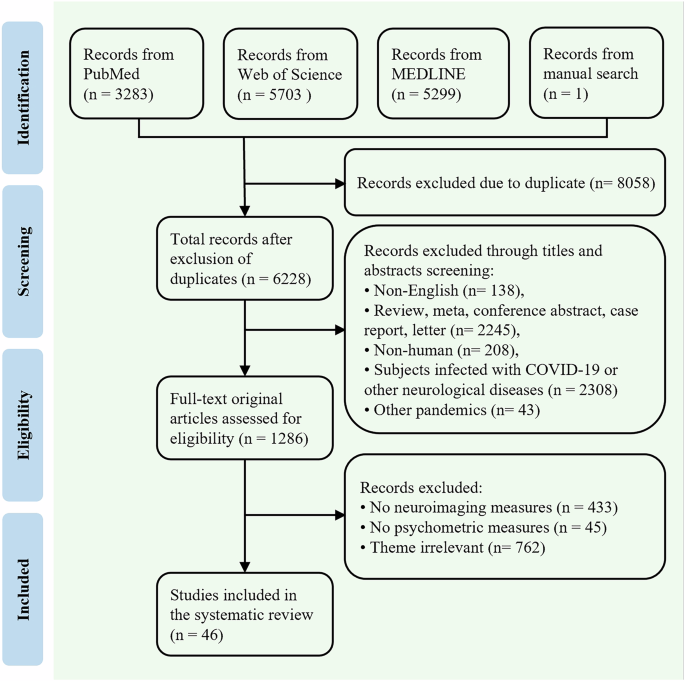
Moher D, Liberati A, Tetzlaff J, Altman DG, P. Group. Preferred reporting items for systematic reviews and meta-analyses: the PRISMA statement. PLoS Med. 2009;6:e1000097.
Google Scholar
Dimanova P, Borbás R, Schnider CB, Fehlbaum LV, Raschle NM. Prefrontal cortical thickness, emotion regulation strategy use and COVID-19 mental health. Soc Cogn Affect Neurosci. 2022;17:877–89.
Google Scholar
Liu X, Zhao Y, Li J, Suo X, Gong Q, Wang S. Brain structure and functional connectivity linking childhood cumulative trauma to COVID-19 vicarious traumatization. J Child Psychol Psychiatry. 2024;65:1407–18.
Google Scholar
Borbás R, Fehlbaum LV, Dimanova P, Negri A, Arudchelvam J, Schnider CB, et al. Mental well-being during the first months of Covid-19 in adults and children: behavioral evidence and neural precursors. Sci Rep. 2021;11:17595.
Google Scholar
Zhang P, Piao Y, Chen Y, Ren J, Zhang L, Qiu B, et al. Outbreak of COVID-19 altered the relationship between memory bias and depressive degree in nonclinical depression. iScience. 2021;24:102081.
Google Scholar
Abe K, Tei S, Takahashi H, Fujino J. Structural brain correlates of burnout severity in medical professionals: a voxel-based morphometric study. Neurosci Lett. 2022;772:136484.
Google Scholar
Lan H, Suo X, Zuo C, Pan N, Zhang X, Kemp GJ, et al. Distinct pre-COVID brain structural signatures in COVID-19-related post-traumatic stress symptoms and post-traumatic growth. Cereb Cortex. 2023;33:11373–83.
Google Scholar
Li T, Du X, Zhang X, Dong A, Yuan X, Yu T, et al. From study abroad to study at home: spontaneous neuronal activity predicts depressive symptoms in overseas students during the COVID-19 pandemic. Front Neurosci. 2023;17:1078119.
Google Scholar
Li Q, Zhang X, Yang X, Pan N, Li X, Kemp GJ, et al. Pre-COVID brain network topology prospectively predicts social anxiety alterations during the COVID-19 pandemic. Neurobiol Stress. 2023;27:100578.
Google Scholar
He L, Wei D, Yang F, Zhang J, Cheng W, Feng J, et al. Functional connectome prediction of anxiety related to the COVID-19 pandemic. Am J Psychiatry. 2021;178:530–40.
Google Scholar
Mao Y, Chen Q, Wei D, Yang W, Sun J, Yu Y, et al. Resting-state functional connectome predicts individual differences in depression during COVID-19 pandemic. Am Psychol. 2022;77:760–9.
Google Scholar
Chahal R, Ho TC, Miller JG, Borchers LR, Gotlib IH. Sex-specific vulnerability to depressive symptoms across adolescence and during the COVID-19 pandemic: The role of the cingulum bundle. JCPP Adv. 2022;2:e12061.
Google Scholar
Lai H, Zhao Y, Li J, Gong Q, Wang S. Neuroanatomical signatures associated with dispositional optimism predict COVID-19-related posttraumatic stress symptoms. Cereb Cortex. 2023;33:9387–98.
Google Scholar
Hardi FA, Goetschius LG, McLoyd V, Lopez-Duran NL, Mitchell C, Hyde LW, et al. Adolescent functional network connectivity prospectively predicts adult anxiety symptoms related to perceived COVID-19 economic adversity. J Child Psychol Psychiatry. 2023;64:918–29.
Google Scholar
Sequeira SL, Silk JS, Hutchinson E, Jones NP, Ladouceur CD. Neural responses to social reward predict depressive symptoms in adolescent girls during the COVID-19 pandemic. J Pediatr Psychol. 2021;46:915–26.
Google Scholar
Khorrami KJ, Manzler CA, Kreutzer KA, Gorka SM. Neural and self-report measures of sensitivity to uncertainty as predictors of COVID-related negative affect. Psychiatry Res Neuroimaging. 2022;319:111414.
Google Scholar
Zhang X, Li Q, Yang X, Pan N, Suo X, He M, et al. Pre-coronavirus disease 2019 brain structure might be associated with social anxiety alterations during the pandemic. Chin Med J (Engl). 2023;136:1621–3.
Google Scholar
Li Q, Zhang X, Yang X, Pan N, He M, Suo X, et al. Pre-COVID resting-state brain activity in the fusiform gyrus prospectively predicts social anxiety alterations during the pandemic. J Affect Disord. 2024;344:380–8.
Google Scholar
Suo X, Zuo C, Lan H, Pan N, Zhang X, Kemp GJ, et al. COVID-19 vicarious traumatization links functional connectome to general distress. Neuroimage. 2022;255:119185.
Google Scholar
Weissman DG, Rodman AM, Rosen ML, Kasparek S, Mayes M, Sheridan MA, et al. Contributions of emotion regulation and brain structure and function to adolescent internalizing problems and stress vulnerability during the COVID-19 pandemic: a longitudinal study. Biol Psychiatry Glob Open Sci. 2021;1:272–82.
Google Scholar
Pan N, Qin K, Yu Y, Long Y, Zhang X, He M, et al. Pre-COVID brain functional connectome features prospectively predict emergence of distress symptoms after onset of the COVID-19 pandemic. Psychol Med. 2023;53:5155–66.
Google Scholar
Sacu S, Dubois M, Hezemans FH, Aggensteiner PM, Monninger M, Brandeis D, et al. Early-life adversities are associated with lower expected value signaling in the adult brain. Biol Psychiatry. 2024;96:948–58.
Google Scholar
Perica MI, Ravindranath O, Calabro FJ, Foran W, Luna B. Hippocampal-prefrontal connectivity prior to the COVID-19 pandemic predicts stress reactivity. Biol Psychiatry Glob Open Sci. 2021;1:283–90.
Google Scholar
Pan N, Wang S, Lan H, Zhang X, Qin K, Kemp GJ, et al. Multivariate patterns of brain functional connectome associated with COVID-19-related negative affect symptoms. Transl Psychiatry. 2024;14:49.
Google Scholar
Chan MY, Park DC, Savalia NK, Petersen SE, Wig GS. Decreased segregation of brain systems across the healthy adult lifespan. Proc Natl Acad Sci USA. 2014;111:E4997–5006.
Google Scholar
Cabello-Toscano M, Vaqué-Alcázar L, Cattaneo G, Solana-Sánchez J, Bayes-Marin I, Abellaneda-Pérez K, et al. Functional brain connectivity prior to the COVID-19 Outbreak moderates the effects of coping and perceived stress on mental health changes: a first year of COVID-19 pandemic follow-up study. Biol Psychiatry Cogn Neurosci Neuroimaging. 2023;8:200–9.
Google Scholar
Feng P, Chen Z, Becker B, Liu X, Zhou F, He Q, et al. Predisposing variations in fear-related brain networks prospectively predict fearful feelings during the 2019 coronavirus (COVID-19) pandemic. Cereb Cortex. 2022;32:540–53.
Google Scholar
Zhang S, Cui J, Zhang Z, Wang Y, Liu R, Chen X, et al. Functional connectivity of amygdala subregions predicts vulnerability to depression following the COVID-19 pandemic. J Affect Disord. 2022;297:421–9.
Google Scholar
Miller JG, Ho TC, Kirshenbaum JS, Chahal R, Gifuni AJ, Gotlib IH. Testing a developmental model of positive parenting, amygdala-subgenual anterior cingulate cortex connectivity, and depressive symptoms in adolescents before and during the COVID-19 pandemic. Biol Psychiatry Glob Open Sci. 2021;1:291–9.
Google Scholar
Holt-Gosselin B, Cohodes EM, McCauley S, Foster JC, Odriozola P, Zacharek SJ, et al. Lack of robust associations between prepandemic coping strategies and frontolimbic circuitry with depression and anxiety symptoms during the COVID-19 pandemic: a preregistered longitudinal study. Behav Neurosci. 2022;136:528–40.
Google Scholar
Chahal R, Kirshenbaum JS, Miller JG, Ho TC, Gotlib IH. Higher executive control network coherence buffers against puberty-related increases in internalizing symptoms during the COVID-19 pandemic. Biol Psychiatry Cogn Neurosci Neuroimaging. 2021;6:79–88.
Google Scholar
Liu X, Zhao Y, Suo X, Zhang X, Pan N, Kemp GJ, et al. Psychological resilience mediates the protective role of default-mode network functional connectivity against COVID-19 vicarious traumatization. Transl Psychiatry. 2023;13:231.
Google Scholar
Zhang Y, Guo L, Gu Z, Yang Q, Han S, Zhang H. Short-term restriction of physical and social activities effects on brain structure and connectivity. Brain Sci. 2024;15:7.
Google Scholar
Xiao M, Chen X, Yi H, Luo Y, Yan Q, Feng T, et al. Stronger functional network connectivity and social support buffer against negative affect during the COVID-19 outbreak and after the pandemic peak. Neurobiol Stress. 2021;15:100418.
Google Scholar
Hu L, Stamoulis C. Strength and resilience of developing brain circuits predict adolescent emotional and stress responses during the COVID-19 pandemic. Cereb Cortex. 2024;34:bhae164.
Google Scholar
Rogala J, Dreszer J, Malinowska U, Waligóra M, Pluta A, Antonova I, et al. Stronger connectivity and higher extraversion protect against stress-related deterioration of cognitive functions. Sci Rep. 2021;11:17452.
Google Scholar
LoMauro A, Molisso MT, Mameli F, Ruggiero F, Ferrucci R, Dellarosa C, et al. EEG evaluation of stress exposure on healthcare workers during COVID-19 emergency: not just an impression. Front Syst Neurosci. 2022;16:923576.
Google Scholar
Dell’Acqua C, Moretta T, Dal Bò E, Messerotti Benvenuti S, Palomba D. Emotional processing prospectively modulates the impact of anxiety on COVID-19 pandemic-related post-traumatic stress symptoms: an ERP study. J Affect Disord. 2022;303:245–54.
Google Scholar
Morales S, Zeytinoglu S, Buzzell GA, Valadez EA, Troller-Renfree SV, Bowers ME, et al. Neurocognitive profiles in adolescence predict subsequent anxiety trajectories during the COVID-19 pandemic. Biol Psychiatry Cogn Neurosci Neuroimaging. 2022;7:192–200.
Google Scholar
Riesel A, Härpfer K, Kathmann N, Klawohn J. In the face of potential harm: the predictive validity of neural correlates of performance monitoring for perceived risk, stress, and internalizing psychopathology during the COVID-19 pandemic. Biol Psychiatry Glob Open Sci. 2021;1:300–9.
Google Scholar
Perellón-Alfonso R, Redondo-Camós M, Abellaneda-Pérez K, Cattaneo G, Delgado-Gallén S, España-Irla G, et al. Prefrontal reactivity to TMS perturbation as a toy model of mental health outcomes during the COVID-19 pandemic. Heliyon. 2022;8:e10208.
Google Scholar
Luo L, Shan M, Zu Y, Chen Y, Bu L, Wang L, et al. Effects of long-term COVID-19 confinement and music stimulation on mental state and brain activity of young people. Neurosci Lett. 2022;791:136922.
Google Scholar
Pessoa L. Emotion and cognition and the amygdala: from “what is it?” to “what’s to be done?”. Neuropsychologia. 2010;48:3416–29.
Google Scholar
Kim MJ, Loucks RA, Palmer AL, Brown AC, Solomon KM, Marchante AN, et al. The structural and functional connectivity of the amygdala: from normal emotion to pathological anxiety. Behav Brain Res. 2011;223:403–10.
Google Scholar
Coccaro EF, McCloskey MS, Fitzgerald DA, Phan KL. Amygdala and orbitofrontal reactivity to social threat in individuals with impulsive aggression. Biol Psychiatry. 2007;62:168–78.
Google Scholar
Buckholtz JW, Callicott JH, Kolachana B, Hariri AR, Goldberg TE, Genderson M, et al. Genetic variation in MAOA modulates ventromedial prefrontal circuitry mediating individual differences in human personality. Mol Psychiatry. 2008;13:313–24.
Google Scholar
Etkin A, Prater KE, Schatzberg AF, Menon V, Greicius MD. Disrupted amygdalar subregion functional connectivity and evidence of a compensatory network in generalized anxiety disorder. Arch Gen Psychiatry. 2009;66:1361–72.
Google Scholar
Marsh AA, Finger EC, Mitchell DG, Reid ME, Sims C, Kosson DS, et al. Reduced amygdala response to fearful expressions in children and adolescents with callous-unemotional traits and disruptive behavior disorders. Am J Psychiatry. 2008;165:712–20.
Google Scholar
Erk S, Mikschl A, Stier S, Ciaramidaro A, Gapp V, Weber B, et al. Acute and sustained effects of cognitive emotion regulation in major depression. J Neurosci. 2010;30:15726–34.
Google Scholar
Baxter MG, Murray EA. The amygdala and reward. Nat Rev Neurosci. 2002;3:563–73.
Google Scholar
Ressler KJ. Amygdala activity, fear, and anxiety: modulation by stress. Biol Psychiatry. 2010;67:1117–9.
Google Scholar
Suarez-Jimenez B, Albajes-Eizagirre A, Lazarov A, Zhu X, Harrison BJ, Radua J, et al. Neural signatures of conditioning, extinction learning, and extinction recall in posttraumatic stress disorder: a meta-analysis of functional magnetic resonance imaging studies. Psychol Med. 2020;50:1442–51.
Google Scholar
Peterson A, Thome J, Frewen P, Lanius RA. Resting-state neuroimaging studies: a new way of identifying differences and similarities among the anxiety disorders? Can J Psychiatry. 2014;59:294–300.
Google Scholar
Mulders PC, van Eijndhoven PF, Schene AH, Beckmann CF, Tendolkar I. Resting-state functional connectivity in major depressive disorder: a review. Neurosci Biobehav Rev. 2015;56:330–44.
Google Scholar
Nicholson AA, Rabellino D, Densmore M, Frewen PA, Paret C, Kluetsch R, et al. The neurobiology of emotion regulation in posttraumatic stress disorder: Amygdala downregulation via real-time fMRI neurofeedback. Hum Brain Mapp. 2017;38:541–60.
Google Scholar
Seeley WW, Menon V, Schatzberg AF, Keller J, Glover GH, Kenna H, et al. Dissociable intrinsic connectivity networks for salience processing and executive control. J Neurosci. 2007;27:2349–56.
Google Scholar
Turner BM, Rodriguez CA, Liu Q, Molloy MF, Hoogendijk M, McClure SM. On the neural and mechanistic bases of self-control. Cereb Cortex. 2019;29:732–50.
Google Scholar
Gagnepain P, Hulbert J, Anderson MC. Parallel regulation of memory and emotion supports the suppression of intrusive memories. J Neurosci. 2017;37:6423–41.
Google Scholar
Wessing I, Rehbein MA, Postert C, Fürniss T, Junghöfer M. The neural basis of cognitive change: reappraisal of emotional faces modulates neural source activity in a frontoparietal attention network. Neuroimage. 2013;81:15–25.
Google Scholar
Brewin CR, Gregory JD, Lipton M, Burgess N. Intrusive images in psychological disorders: characteristics, neural mechanisms, and treatment implications. Psychol Rev. 2010;117:210–32.
Google Scholar
Banich MT, Mackiewicz KL, Depue BE, Whitmer AJ, Miller GA, Heller W. Cognitive control mechanisms, emotion and memory: a neural perspective with implications for psychopathology. Neurosci Biobehav Rev. 2009;33:613–30.
Google Scholar
Forbes NF, Carrick LA, McIntosh AM, Lawrie SM. Working memory in schizophrenia: a meta-analysis. Psychol Med. 2009;39:889–905.
Google Scholar
Niendam TA, Laird AR, Ray KL, Dean YM, Glahn DC, Carter CS. Meta-analytic evidence for a superordinate cognitive control network subserving diverse executive functions. Cogn Affect Behav Neurosci. 2012;12:241–68.
Google Scholar
Leyman L, De Raedt R, Vanderhasselt MA, Baeken C. Influence of high-frequency repetitive transcranial magnetic stimulation over the dorsolateral prefrontal cortex on the inhibition of emotional information in healthy volunteers. Psychol Med. 2009;39:1019–28.
Google Scholar
Lyoo IK, Kim JE, Yoon SJ, Hwang J, Bae S, Kim DJ. The neurobiological role of the dorsolateral prefrontal cortex in recovery from trauma. Longitudinal brain imaging study among survivors of the South Korean subway disaster. Arch Gen Psychiatry. 2011;68:701–13.
Google Scholar
Campbell-Sills L, Simmons AN, Lovero KL, Rochlin AA, Paulus MP, Stein MB. Functioning of neural systems supporting emotion regulation in anxiety-prone individuals. Neuroimage. 2011;54:689–96.
Google Scholar
Kaiser RH, Andrews-Hanna JR, Wager TD, Pizzagalli DA. Large-scale network dysfunction in major depressive disorder: a meta-analysis of resting-state functional connectivity. JAMA Psychiatry. 2015;72:603–11.
Google Scholar
Woodward ND, Rogers B, Heckers S. Functional resting-state networks are differentially affected in schizophrenia. Schizophr Res. 2011;130:86–93.
Google Scholar
Menon V, Anagnoson RT, Mathalon DH, Glover GH, Pfefferbaum A. Functional neuroanatomy of auditory working memory in schizophrenia: relation to positive and negative symptoms. Neuroimage. 2001;13:433–46.
Google Scholar
Joshi SA, Duval ER, Kubat B, Liberzon I. A review of hippocampal activation in post-traumatic stress disorder. Psychophysiology. 2020;57:e13357.
Google Scholar
van Ettinger-Veenstra H, Boehme R, Ghafouri B, Olausson H, Wicksell RK, Gerdle B. Exploration of functional connectivity changes previously reported in fibromyalgia and their relation to psychological distress and pain measures. J Clin Med. 2020;9:3560.
Google Scholar
Boyd JE, Lanius RA, McKinnon MC. Mindfulness-based treatments for posttraumatic stress disorder: a review of the treatment literature and neurobiological evidence. J Psychiatry Neurosci. 2018;43:7–25.
Google Scholar
Sylvester CM, Corbetta M, Raichle ME, Rodebaugh TL, Schlaggar BL, Sheline YI, et al. Functional network dysfunction in anxiety and anxiety disorders. Trends Neurosci. 2012;35:527–35.
Google Scholar
Whitfield-Gabrieli S, Thermenos HW, Milanovic S, Tsuang MT, Faraone SV, McCarley RW, et al. Hyperactivity and hyperconnectivity of the default network in schizophrenia and in first-degree relatives of persons with schizophrenia. Proc Natl Acad Sci USA. 2009;106:1279–84.
Google Scholar
Suo X, Chen L, Kemp GJ, Wu D, Wang S. Aberrant structural-functional coupling of large-scale brain networks in older women with subthreshold depression. J Gerontol B Psychol Sci Soc Sci. 2025;80:gbaf013.
Google Scholar
Giustino TF, Maren S. The role of the medial prefrontal cortex in the conditioning and extinction of fear. Front Behav Neurosci. 2015;9:298.
Google Scholar
Frith U, Frith CD. Development and neurophysiology of mentalizing. Philos Trans R Soc Lond B Biol Sci. 2003;358:459–73.
Google Scholar
Burkhouse KL, Jacobs RH, Peters AT, Ajilore O, Watkins ER, Langenecker SA. Neural correlates of rumination in adolescents with remitted major depressive disorder and healthy controls. Cogn Affect Behav Neurosci. 2017;17:394–405.
Google Scholar
Fanselow MS, Dong HW. Are the dorsal and ventral hippocampus functionally distinct structures? Neuron. 2010;65:7–19.
Google Scholar
McHugh SB, Fillenz M, Lowry JP, Rawlins JN, Bannerman DM. Brain tissue oxygen amperometry in behaving rats demonstrates functional dissociation of dorsal and ventral hippocampus during spatial processing and anxiety. Eur J Neurosci. 2011;33:322–37.
Google Scholar
Ressler KJ, Berretta S, Bolshakov VY, Rosso IM, Meloni EG, Rauch SL, et al. Post-traumatic stress disorder: clinical and translational neuroscience from cells to circuits. Nat Rev Neurol. 2022;18:273–88.
Google Scholar
Koch SB, van Zuiden M, Nawijn L, Frijling JL, Veltman DJ, Olff M. ABERRANT RESTING-STATE BRAIN ACTIVITY IN POSTTRAUMATIC STRESS DISORDER: A META-ANALYSIS AND SYSTEMATIC REVIEW. Depress Anxiety. 2016;33:592–605.
Google Scholar
Rauch SL, Shin LM, Phelps EA. Neurocircuitry models of posttraumatic stress disorder and extinction: human neuroimaging research–past, present, and future. Biol Psychiatry. 2006;60:376–82.
Google Scholar
Ballmaier M, Toga AW, Blanton RE, Sowell ER, Lavretsky H, Peterson J, et al. Anterior cingulate, gyrus rectus, and orbitofrontal abnormalities in elderly depressed patients: an MRI-based parcellation of the prefrontal cortex. Am J Psychiatry. 2004;161:99–108.
Google Scholar
Thomaes K, Dorrepaal E, Draijer N, de Ruiter MB, Elzinga BM, Sjoerds Z, et al. Increased anterior cingulate cortex and hippocampus activation in Complex PTSD during encoding of negative words. Soc Cogn Affect Neurosci. 2013;8:190–200.
Google Scholar
Etkin A, Egner T, Kalisch R. Emotional processing in anterior cingulate and medial prefrontal cortex. Trends Cogn Sci. 2011;15:85–93.
Google Scholar
Rive MM, van Rooijen G, Veltman DJ, Phillips ML, Schene AH, Ruhé HG. Neural correlates of dysfunctional emotion regulation in major depressive disorder. A systematic review of neuroimaging studies. Neurosci Biobehav Rev. 2013;37:2529–53.
Google Scholar
Robinson OJ, Krimsky M, Lieberman L, Allen P, Vytal K, Grillon C. Towards a mechanistic understanding of pathological anxiety: the dorsal medial prefrontal-amygdala ‘aversive amplification’ circuit in unmedicated generalized and social anxiety disorders. Lancet Psychiatry. 2014;1:294–302.
Google Scholar
Schiller D, Delgado MR. Overlapping neural systems mediating extinction, reversal and regulation of fear. Trends Cogn Sci. 2010;14:268–76.
Google Scholar
Li L, Xu Z, Chen L, Suo X, Fu S, Wang S, et al. Dysconnectivity of the amygdala and dorsal anterior cingulate cortex in drug-naive post-traumatic stress disorder. Eur Neuropsychopharmacol. 2021;52:84–93.
Google Scholar
Ibañez A, Gleichgerrcht E, Manes F. Clinical effects of insular damage in humans. Brain Struct Funct. 2010;214:397–410.
Google Scholar
Paulus MP, Stein MB. An insular view of anxiety. Biol Psychiatry. 2006;60:383–7.
Google Scholar
Nitschke JB, Sarinopoulos I, Mackiewicz KL, Schaefer HS, Davidson RJ. Functional neuroanatomy of aversion and its anticipation. Neuroimage. 2006;29:106–16.
Google Scholar
Hoehn-Saric R, Schlund MW, Wong SH. Effects of citalopram on worry and brain activation in patients with generalized anxiety disorder. Psychiatry Res. 2004;131:11–21.
Google Scholar
Schimmelpfennig J, Topczewski J, Zajkowski W, Jankowiak-Siuda K. The role of the salience network in cognitive and affective deficits. Front Hum Neurosci. 2023;17:1133367.
Google Scholar
Ehrhardt NM, Fietz J, Kopf-Beck J, Kappelmann N, Brem AK. Separating EEG correlates of stress: cognitive effort, time pressure, and social-evaluative threat. Eur J Neurosci. 2022;55:2464–73.
Google Scholar
Marshall AC, Cooper NR. The association between high levels of cumulative life stress and aberrant resting state EEG dynamics in old age. Biol Psychol. 2017;127:64–73.
Google Scholar
Müller-Putz GR. Electroencephalography. Handb Clin Neurol. 2020;168:249–62.
Google Scholar
Lian J, Xu L, Song T, Peng Z, Zhang Z, An X, et al. Reduced resting-state EEG power spectra and functional connectivity after 24 and 36 h of sleep deprivation. Brain Sci. 2023;13:949.
Google Scholar
Fingelkurts AA, Fingelkurts AA, Kähkönen S. Functional connectivity in the brain–is it an elusive concept? Neurosci Biobehav Rev. 2005;28:827–36.
Google Scholar
Hajcak G, MacNamara A, Olvet DM. Event-related potentials, emotion, and emotion regulation: an integrative review. Dev Neuropsychol. 2010;35:129–55.
Google Scholar
Foti D, Olvet DM, Klein DN, Hajcak G. Reduced electrocortical response to threatening faces in major depressive disorder. Depress Anxiety. 2010;27:813–20.
Google Scholar
Kujawa A, MacNamara A, Fitzgerald KD, Monk CS, Phan KL. Enhanced neural reactivity to threatening faces in anxious youth: evidence from event-related potentials. J Abnorm Child Psychol. 2015;43:1493–501.
Google Scholar
MacNamara A, Jackson TB, Fitzgerald JM, Hajcak G, Phan KL. Working memory load and negative picture processing: neural and behavioral associations with panic, social anxiety, and positive affect. Biol Psychiatry Cogn Neurosci Neuroimaging. 2019;4:151–9.
Google Scholar
Rocchi L, Ibáñez J, Benussi A, Hannah R, Rawji V, Casula E, et al. Variability and predictors of response to continuous theta burst stimulation: a TMS-EEG study. Front Neurosci. 2018;12:400.
Google Scholar
Xia W, Dai R, Xu X, Huai B, Bai Z, Zhang J, et al. Cortical mapping of active and passive upper limb training in stroke patients and healthy people: a functional near-infrared spectroscopy study. Brain Res. 2022;1788:147935.
Google Scholar
Mantini D, Marzetti L, Corbetta M, Romani GL, Del Gratta C. Multimodal integration of fMRI and EEG data for high spatial and temporal resolution analysis of brain networks. Brain Topogr. 2010;23:150–8.
Google Scholar
Kaneta T. PET and SPECT imaging of the brain: a review on the current status of nuclear medicine in Japan. Jpn J Radiol. 2020;38:343–57.
Google Scholar
Jamieson D, Kannis-Dymand L, Beaudequin DA, Schwenn P, Shan Z, McLoughlin LT, et al. Can measures of sleep quality or white matter structural integrity predict level of worry or rumination in adolescents facing stressful situations? Lessons from the COVID-19 pandemic. J Adolesc. 2021;91:110–18.
Google Scholar
Zheng A, Chen X, Xiang G, Li Q, Du X, Liu X, et al. Association between negative affect and perceived mortality threat during the COVID-19 pandemic: the role of brain activity and connectivity. Neuroscience. 2023;535:63–74.
Google Scholar
link