Stress-Buffer-Hypothesis: blood endocannabinoids in healthy males under standardized psychosocial stress induction and resting condition
Study participants
N = 32 healthy participants were recruited via newspaper advertisements. Inclusion criteria embraced an age between 18 and 65, male sex, and fluency in the German language. Furthermore, the healthy participants were tested for psychological disorders by a standardized interview using the Structured Clinical Interview both for axis I and II [24]. Exclusion criteria involved any kind of psychological diagnoses, medication or substance intake, stressful life events in the previous six months, and severe chronic physical diseases, such as diabetes or cancer. The mean age of the 32 male participants was 24.19 (SD = 4.03) with a mean BMI of 22.83 kg/m² (SD = 1.68). Three of the 29 lastly included participants were smokers (under 10 cigarettes per day). A description of the 32 male participants is given in Table 1. All study participants provided written informed consent, and the study protocol was approved by the local ethics committee of the State Medical Association of Rhineland-Palatinate, Germany (No. 2019-14188).
Procedures
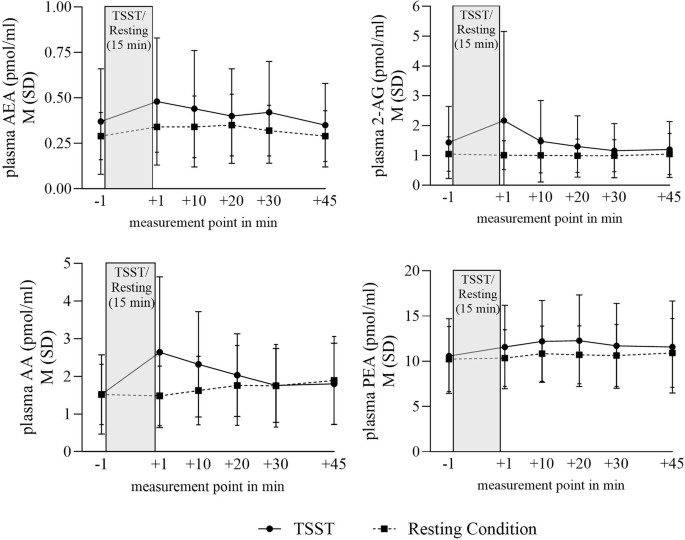
Data collection of the 32 male healthy participants was conducted from May 2019 to July 2020. The participants underwent a stress and rest conditions on different days over a total period of seven days. The test order of the two conditions (stress and rest) was randomized, and the start of each condition was scheduled between 2:00 p.m. and 5:00 p.m. to minimize the impact of significant circadian cortisol level fluctuations. The participants were instructed not to eat, drink, or smoke for up to two hours before the testing session to ensure uniform testing conditions and prerequisites for all. Forty-five minutes before the first blood collection, the intravenous cannula was inserted to avoid a pain-induced endocannabinoids and cortisol release. The standardization of the stress induction was based on the Trier Social Stress Test (TSST) introduced by [21]. The TSST is designed to induce acute psychosocial stress in a controlled laboratory environment. This stress protocol involves a social-evaluative scenario that includes a five-minute simulated job interview followed by a five-minute mental arithmetic task, both of which are performed in front of two evaluators. A detailed description and assessment of the effectiveness of this psychosocial stress protocol can be found in [25]. During the rest condition, the participants were given the opportunity to read magazines. The experimental protocol began with a 15-min pre-session. The first blood sample was collected one minute before the start of the 15-min conditions (stress and rest). Three minutes after the onset of the corresponding condition, cognitive assessment was assessed with the Primary Appraisal Secondary Appraisal (PASA; 28). Immediately after both conditions, a second blood sample was collected and self-reported stress perception was measured with the visual analog scale (VAS). During the recovery phase, the participants were reposing in supine position on a surgery bed, while seven further blood samples (+10, +20, +30, +45, +60, +75 and +105 min) were collected.
Blood analytics
To assess plasma endocannabinoids concentrations, blood samples were collected in monovettes containing containing ethylenediaminetetraacetic acid (EDTA) (Sarstedt, Nümbrecht, Germany). Following collection, the EDTA monovettes were promptly centrifuged at 4 °C and 2000 g for 10 min. The endocannabinoid concentrations of arachidonic acid (AA), arachidonoylethanolamide (AEA), isomeres 2-AG arachidonoylglycerol (2-AG) and palitoylethanolamide (PEA) were determined. Details regarding the extraction and analysis of endocannabinoids can be found in previously described protocols [23]. For the determination of serum cortisol levels, blood samples were obtained in serum gel monovettes (S-Monovette® 9 ml Z, Sarstedt, Nümbrecht, Germany). These monovettes were left at room temperature for 30 min to facilitate blood coagulation. Upon coagulation, the serum monovettes were centrifuged for 10 min at 2500 g and 20 °C. Serum cortisol concentrations were assessed using a commercially available enzyme-linked immunosorbent assay (ELISA) kit.
Psychological and clinical measures
The psychological and general status of the participants was measured by means of six instruments: (1.) The Symptom-Check-List-90-R (SCL) [26] which is a self-report instrument for assessing psychological and physical impairments, which consists of 90 items with a five-point rating scale (Cronbach’s Alpha-coefficient in the current sample α = 0.95). (2.) The Perceived Stress Scale (PSS) constructed by [27] that measures the perception of stress and consists of 14 items with a five-point Likert scale ranging from 1 (never) to 5 (very often). The reliability (Cronbach’s Alpha-coefficient) of the 14 items in the current sample was α = 0.75. The (3rd) Beck Depression Inventory (BDI) [28] is used to assess severity of depressive symptoms based on 21 items (total score range: 0 – 63). The reliability (Cronbach’s Alpha-coefficient) of the 21 items in the current sample was α = 0.76. (4.) The Trier Inventory for Chronic Stress (TICS) [29] that measures the participants’ perceived chronic stress during the previous three months (Cronbach’s Alpha-coefficient in the current sample α = 0.92). (5.) The Freiburg Physical Activity Questionnaire (FFKA) [30] was used to assess the different types of daily activity. The reliability (Cronbach’s Alpha-coefficient) of the 21 items in the current sample was α = 0.75. (6.) The tendency to fear anxiety – related sensations and personal sensitivity to fearing symptoms (somatic and cognitive) is assessed by the Anxiety Sensitivity Index (ASI) [31] with 16 items (Cronbach’s Alpha-coefficient in the current sample α = 0.79). (7) The Spielberger State-Trait Anxiety Inventory (STAI) [32] was used to assess the trait anxiety (Cronbach’s Alpha-coefficient in the current sample α = 0.91).
The Primary Appraisal Secondary Appraisal (PASA) [28] was measured three minutes after the start of each condition to assess the cognitive appraisal processes. The questionnaire consists of 16 items rated on a six-point Likert scale (1 = strongly disagree to 6 = strongly agree), allowing for the calculation of Primary Appraisal, Secondary Appraisal, and the Stress Index. Before and after both conditions, the temporary emotional state of anxiety was assessed by the state anxiety scale (20 items) of the Spielberger State-Trait Anxiety Inventory (STAI) [32]. The visual analogous scale (VAS) was used to assess self-reported feelings of stress after both conditions. This ranges from 0, which corresponds to no stress at all, to 100, which equates to maximum stress.
Statistical analyses
The software program used to analyze the data was SPSS Statistics version 27 (IBM, Chicago, IL, USA). A power analysis with the G*power program (version: 3.1.9.2.) [33] showed that for a medium effect size of Cohen´s f =0.25, two testing conditions (TSST and resting condition), in each condition at least n = 6 repetitions, significance level of p = 0.05 and power of 95% (1-ß = 0.95), a total sample size of n = 28 participants for ANOVA-repeated measures (within-between interaction) are needed. The data were analyzed according to the normality of distributions and were, in case of not normally distributed data, subjected to logarithm naturalis transformations.
Firstly, the effects of the TSST and the resting condition over six measurement points for the endocannabinoids as well as over nine measurement points for the cortisol concentration were analyzed by the ANOVA for repeated measurements to reveal possible main effect of condition or time and a possible time x condition interaction. The assumption of sphericity was controlled by Mauchly’s test. Whenever necessary, the ANOVA results were corrected by Greenhouse-Geisser. In addition, the delta between peak (either +1, +5, +10, +20, +30, +45, +60, +75, +105 min sample) and baseline (Δ Peak-Base) was calculated [34]. Differences of the calculated values between both conditions were tested by the t-test for dependent means.
Secondly, the success of the stress induction on the cognitive appraisal processes (PASA) and the acute self-reported stress perception (VAS) were tested by the dependent t-test. To reflect the effect of the stress condition on the temporary emotional state of anxiety (STAI-S), ANOVA for repeated measurements with within-factor condition (stress vs. rest) and time (pre vs. post) was analyzed.
Thirdly, Pearson’s correlations were calculated to quantify the relationship between baseline the values of endocannabinoids, cortisol, and psychological (BDI, ASI, PSS, and TICS-SCSS) measures.
Fourthly, the association between acute stress-induced peak values of endocannabinoids/cortisol and subjective acute stress appraisal was tested using Pearson’s correlation test.
link