Physical activity enhances college students’ mental health through social adaptability and exercise behavior chain mediation
Participants
This study surveyed undergraduate students from Zhengzhou University using a convenience sampling method for questionnaire distribution and data collection. A total of 715 questionnaires were collected, of which 525 were deemed valid after rigorous screening, yielding an effective response rate of 73.43%. Exclusion criteria included: (1) more than 30% of items left unanswered; (2) missing key demographic information (e.g., gender, age); and (3) repetitive or patterned responses indicating inattentive completion.
Participants ranged in age from 18 to 22 years (M = 20.1, SD = ± 1.2). The sample consisted of 277 males (52.76%) and 248 females (47.24%). First-year students accounted for 32.57% of the sample, while fourth-year students constituted the smallest proportion at 19.24%. The urban–rural distribution was relatively balanced, with 55.04% from urban backgrounds. Additionally, 32.76% of respondents were only children. The demographic distribution of the survey participants is shown in Table 1. All participants provided informed consent prior to the study, which was approved by the Ethics Committee of the Life Sciences Department at Zhengzhou University (FWA00014064), in accordance with ethical research guidelines.
Instruments and scale design
PE satisfaction scale
Based on the SERVQUAL service quality model and the scale framework developed by Yuan et al.26,27,28, a self-constructed “University PE Satisfaction Scale” was employed. The scale includes 24 items covering five dimensions: sports facilities, teaching quality, extracurricular exercise, perceived value, and overall satisfaction. The scale demonstrated high internal consistency (Cronbach’s = 0.97) and good model fit ( χ2/df = 2.232, RMSEA = 0.042, CFI = 0.903, GFI = 0.911, TLI = 0.912, and IFI = 0.936).
Psychological health assessment (SCL-90-R).
Mental health status was assessed using the widely adopted revised Symptom Checklist-90 (SCL-90-R)29, which evaluates nine dimensions, including mental state, emotional responses, behavior patterns, interpersonal relationships, and sleep and diet. Responses were rated on a five-point Likert scale. The scale demonstrated excellent reliability in this study (Cronbach’s alpha = 0.98), with satisfactory model fit (χ2/df = 2.371, RMSEA = 0.047, CFI = 0.953, GFI = 0.917, TLI = 0.922, and IFI = 0.926).
Social adaptability level measurement
Social adaptability was measured using the Social Adaptability Scale developed by Zheng (1999)30, which has been widely validated and applied in relevant studies31,32. The scale consists of 20 items and adopts a three-point Likert scoring method (1 = “Yes”, 2 = “Uncertain”, 3 = “No”). Odd-numbered items are scored directly, while even-numbered items are reverse scored. Total scores are used to evaluate the overall level of social adaptability, with higher scores indicating better adaptability.
The use of a three-point scale in this context is consistent with the original instrument design. Compared to five-point formats, the three-point scale reduces respondents’ cognitive burden and improves response efficiency, particularly among youth populations. It also minimizes extreme response bias in questions involving emotional or socially sensitive content. Retaining the original scoring system helps ensure consistency in measurement and supports the reliability and validity of the data. In this study, the scale demonstrated excellent internal consistency (Cronbach’s alpha = 0.97), and the model fit indices were satisfactory (χ2/df = 2.521, RMSEA = 0.046, CFI = 0.913, GFI = 0.907, TLI = 0.917, and IFI = 0.933).
Exercise behavior level measurement
Physical activity was assessed using the short form of the International Physical Activity Questionnaire (IPAQ-SF)33,34. This well-established scale categorizes physical activity levels into three intensity levels: vigorous, moderate, and low. The IPAQ-SF records activity over the previous seven days, converting reported duration and frequency into metabolic equivalent task (MET) values based on standardized formulas. Specifically: Vigorous physical activity is assigned 8 METs, Moderate physical activity is assigned 4 METs, Walking is assigned 3.3 METs. Activity levels are classified as follows: Low: MET-min/week ≤ 19, Moderate: 20 ≤ MET-min/week ≤ 42, High: MET-min/week ≥ 43. Since the IPAQ-SF is a mature instrument with established validity and reliability, additional validity testing was not performed. This is consistent with prior research emphasizing its use in large-scale cohort studies where objective measures, such as accelerometers, may not be feasible33,34.
Data processing and analysis
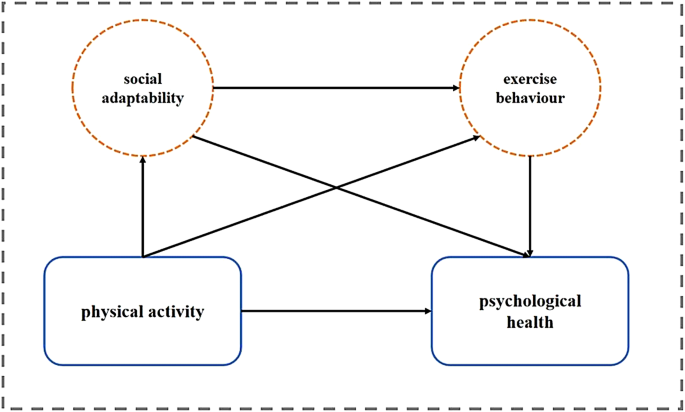
Data were analyzed using SPSS 26.0 and AMOS 26.0 for structural equation modeling. The primary statistical techniques included: (1) Pearson correlation analysis to assess linear relationships between variables; (2) Regression analysis to examine the predictive effects of PE, social adaptability, and physical activity on mental health; (3) Mediation analysis using the PROCESS macro (Model 6), applying 5,000 bootstrap resamples to test the significance of the chain mediation pathways.
Model fit was evaluated using standard indices: χ²/df < 3, RMSEA < 0.08, and CFI, GFI, TLI, IFI all > 0.90, indicating good model fit.
link